

Investment Monthly
Key Takeaways:
House View
- Strong profits continue to drive momentum in global equities, but uncertainty surrounding the durability of AI capex, renewed geopolitical risks, and higher bond yields have the potential to drive episodic volatility
- A selective “broadening out” of performance and profits can benefit better-value regions like emerging markets, Europe, and Japan. The Fed backing away from hiking, possible yield caps, and deficit anxieties could all be catalysts for dollar weakness - which could be a boos for emerging markets
- In a “multi-polar” world with spikey inflation, it makes sense to “diversify the diversifiers”. Investors should consider “anti-bubble” parts of the market which may offer better value, and lower volatility in sell-offs
Macro Outlook
- Re-intensifying Middle East tensions have pushed oil and refined product prices higher; Hormuz traffic remains depressed. Elevated energy prices suggest inflation will be sticky for the rest of 2026
- US domestic demand is solid but K-shaped. AI is providing strong support for some forms of business investment and high-income consumers while other areas are lagging.
- AI and policy buffers have supported Asia’s growth, but it is exposed to the risk of global AI demand shifts and energy supply shocks. China’s growth is resilient amid technology and export strength, but imbalanced
Policy Outlook
- Policy uncertainty is high. Central banks are facing difficult growth-inflation trade-offs due to supply-side shocks. Fiscal and industrial policy is more activist, but elevated government debt is a constraint
- Federal Reserve Chair Warsh warned of “more work to do” if PCE inflation remains above its 2 per cent target. The ECB signalled a near-term rate rise, while the BoE shows little urgency to raise rates
- China’s policy is focused on balancing short-term macro stability with longer-term structural priorities. In Asia, relative exposure to AI and the energy shock is driving a varied pace and scale of policy support
Scenarios
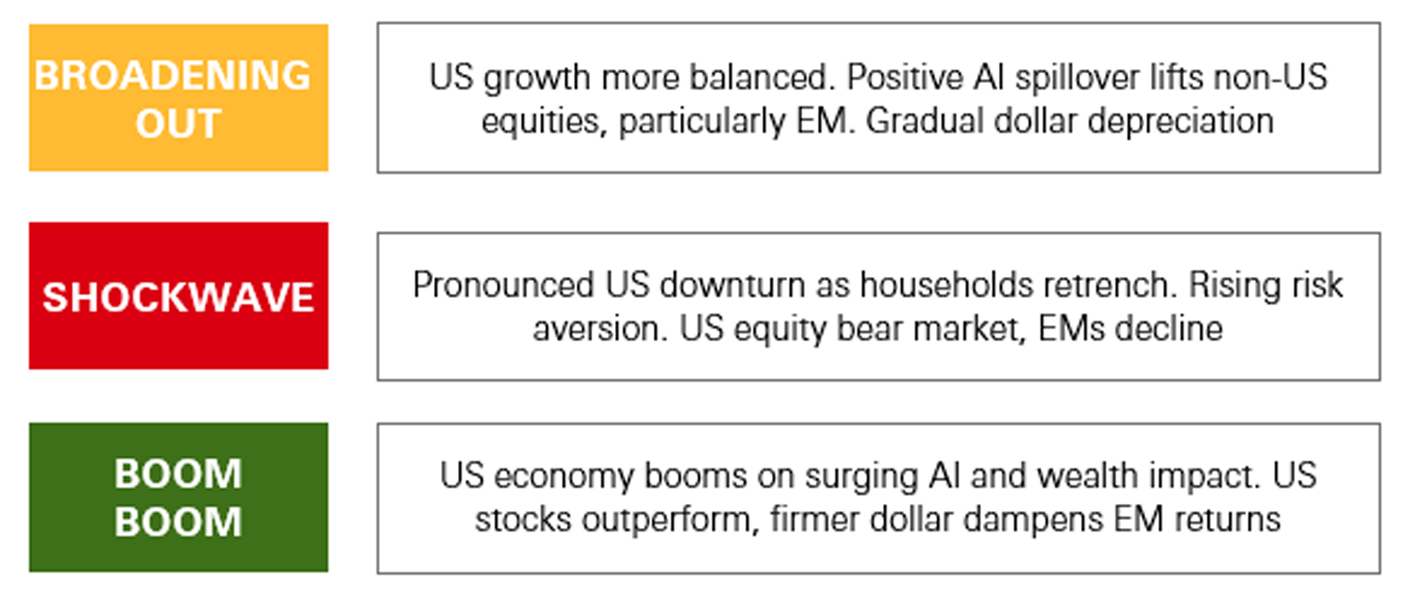
Click the image to enlarge
The commentary and analysis presented in this document reflect the opinion of HSBC Asset Management on the markets, according to the information available to date. They do not constitute any kind of commitment from HSBC Asset Management. Consequently, HSBC Asset Management will not be held responsible for any investment or disinvestment decision taken on the basis of the commentary and/or analysis in this document. Diversification does not ensure a profit or protect against loss. Any forecast, projection or target where provided is indicative only and is not guaranteed in any way. HSBC Asset Management accepts no liability for any failure to meet such forecast, projection or target. For informational purposes only and should not be construed as a recommendation to invest in the specific country, product, strategy, sector, or security.
Source: HSBC Asset Management as at September 2026.
House View
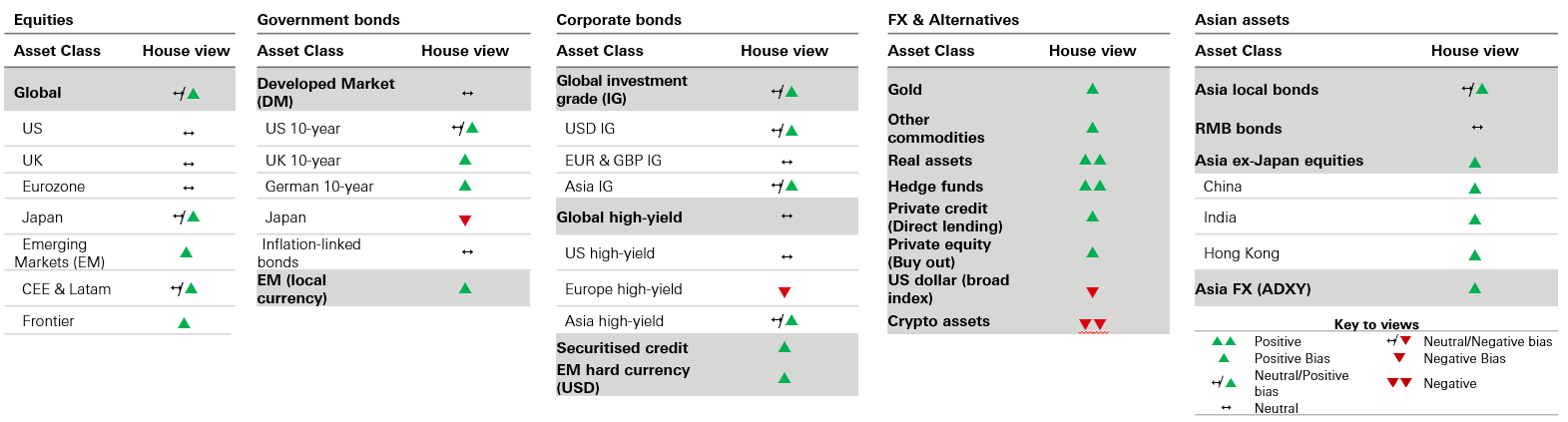
Markets have been resilient but uncertainty around the timing of AI payoffs, geopolitical tensions, and higher bond yields are all potential sources of volatility. A broadening out of profits growthis driving stronger performance in laggard sectors and regions, like Europe. Investors should “diversify the diversifiers” to help build portfolio resilience
- Equities Strong capex should keep AI-related profits flowing, but market performance can broaden out. Other sectors connected to the AI boom, both upstream and downstream, could be the next market leaders
- Government bonds – Longer-dated bond yields remain elevated amid spiky inflation, geopolitical risks, and fiscal “deficits forever”. But this has improved opportunities across fixed income, which could add ballast to portfolios
- Corporate bonds– Investment grade credit spreads remain tight amid robust fundamentals. High yield credit faces pressure from uneven US growth and geopolitics. We maintain a preference for higher quality
Click the image to enlarge
The commentary and analysis presented in this document reflect the opinion of HSBC Asset Management on the markets, according to the information available to date. They do not constitute any kind of commitment from HSBC Asset Management. Consequently, HSBC Asset Management will not be held responsible for any investment or disinvestment decision taken on the basis of the commentary and/or analysis in this document. Past performance does not predict future returns. For informational purposes only and should not be construed as a recommendation to invest in the specific country, product, strategy, sector, or security. Diversification does not ensure a profit or protect against loss. Any forecast, projection or target where provided is indicative only and is not guaranteed in any way. HSBC Asset Management accepts no liability for any failure to meet such forecast, projection or target. You cannot invest directly in an index. The level of yield is not guaranteed and may rise or fall in the future. House view represents a >12-month investment view across major asset classes in our portfolios. Source: HSBC Asset Management as at September 2026.
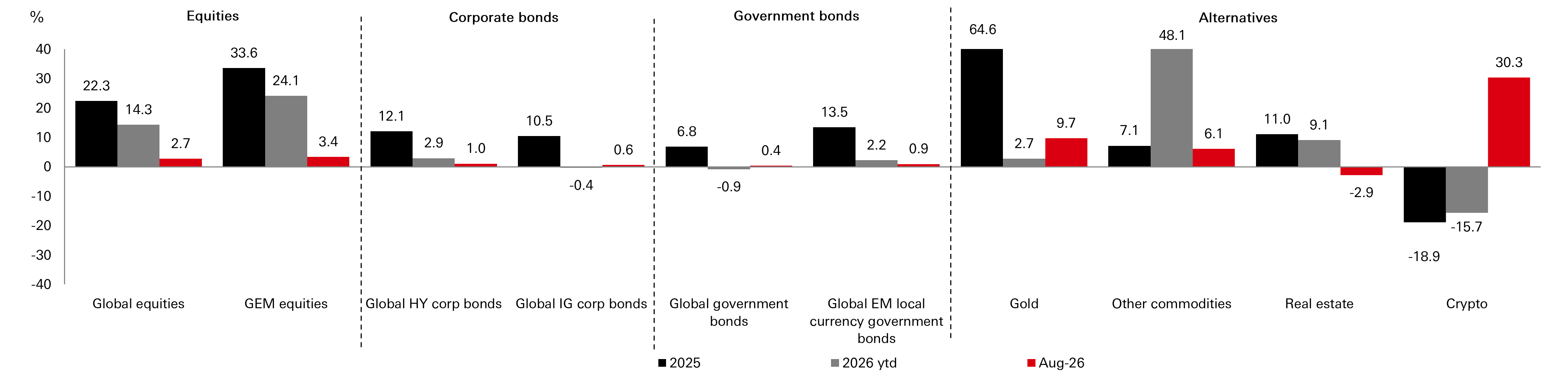
Asset class performance at a glance
It was a tale of two markets in August with long-duration government bonds suffering on concerns over the fiscal outlook and higher-for-longer rates. But developed market stocks advanced on continued AI enthusiasm and strong corporate profits. EM stocks were more mixed. Credit markets remained resilient, while gold and oil prices both rose
- Government bonds – Long duration sovereign bonds fell (yields rose) in response to uncertainty about “deficits forever” and whether growth can keep pace with interest costs. However, real yields and term premia are now “back to normal”
- Equities – Developed market equity indices were positive in August, with decent gains in the US, Japan, and Europe. Tech-heavy markets in Asia also performed well, but the “sleeping giant” markets of China and India were broadly flat
- Alternatives – The gold price rose sharply on US monetary and fiscal uncertainty, as well as ongoing geopolitical tensions. Oil prices continued to be volatile and closed the month higher, while real estate and infrastructure indices lost ground
Click the image to enlarge
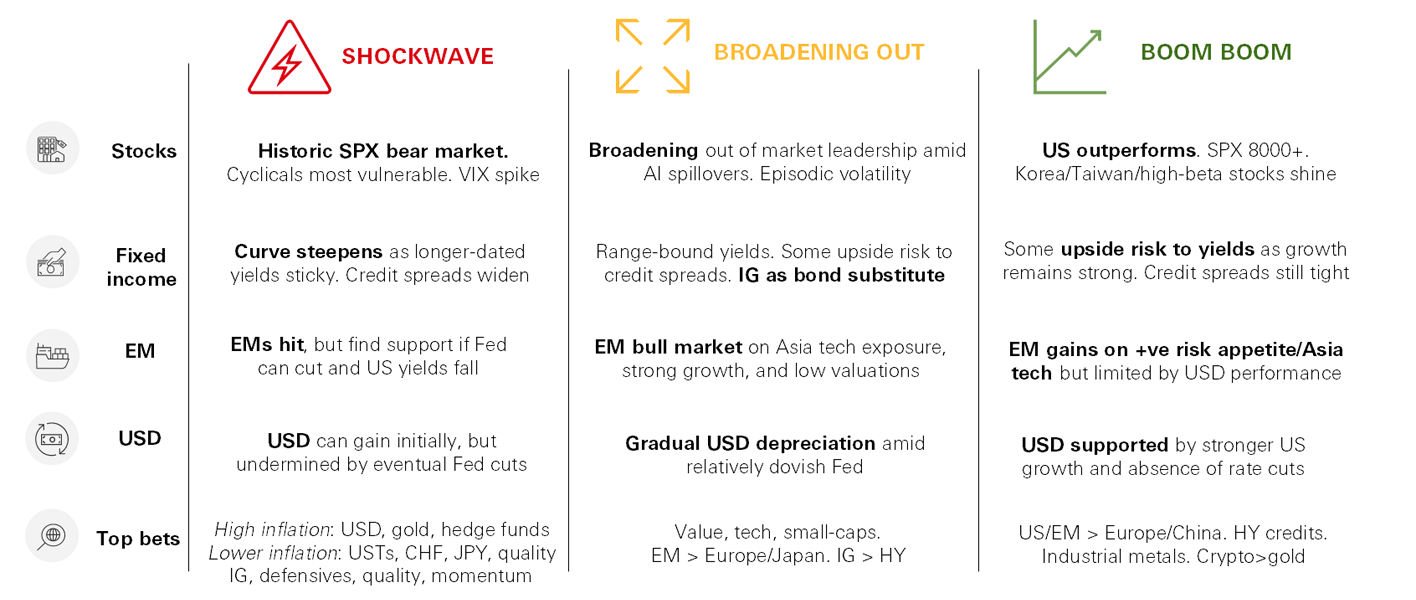
The commentary and analysis presented in this document reflect the opinion of HSBC Asset Management on the markets, according to the information available to date. They do not constitute any kind of commitment from HSBC Asset Management. Consequently, HSBC Asset Management will not be held responsible for any investment or disinvestment decision taken on the basis of the commentary and/or analysis in this document. Past performance does not predict future returns. For informational purposes only and should not be construed as a recommendation to invest in the specific country, product, strategy, sector, or security. The views expressed above were held at the time of preparation and are subject to change without notice. The level of yield is not guaranteed and may rise or fall in the future. Source: Bloomberg, all data above as at close of business 31 August 2026 in USD, total return, month-to-date terms. Note: Asset class performance is represented by different indices. Global Equities: MSCI ACWI Net Total Return USD Index. Global Emerging Market Equities: MSCI Emerging Market Net Total Return USD Index. Corporate Bonds: Bloomberg Barclays Global HY Total Return Index value unhedged. Bloomberg Barclays Global IG Total Return Index unhedged. Government bonds: Bloomberg Barclays Global Aggregate Treasuries Total Return Index. JP Morgan EMBI Global Total Return local currency. Commodities and real estate: Gold Spot $/OZ, Other commodities: S&P GSCI Total Return CME. Real Estate: FTSE EPRA/NAREIT Global Index TR USD. Crypto: Bloomberg Galaxy Crypto Index. Index returns assume reinvestment of all distributions and do not reflect fees or expenses. You cannot invest directly in an index.Macro scenarios
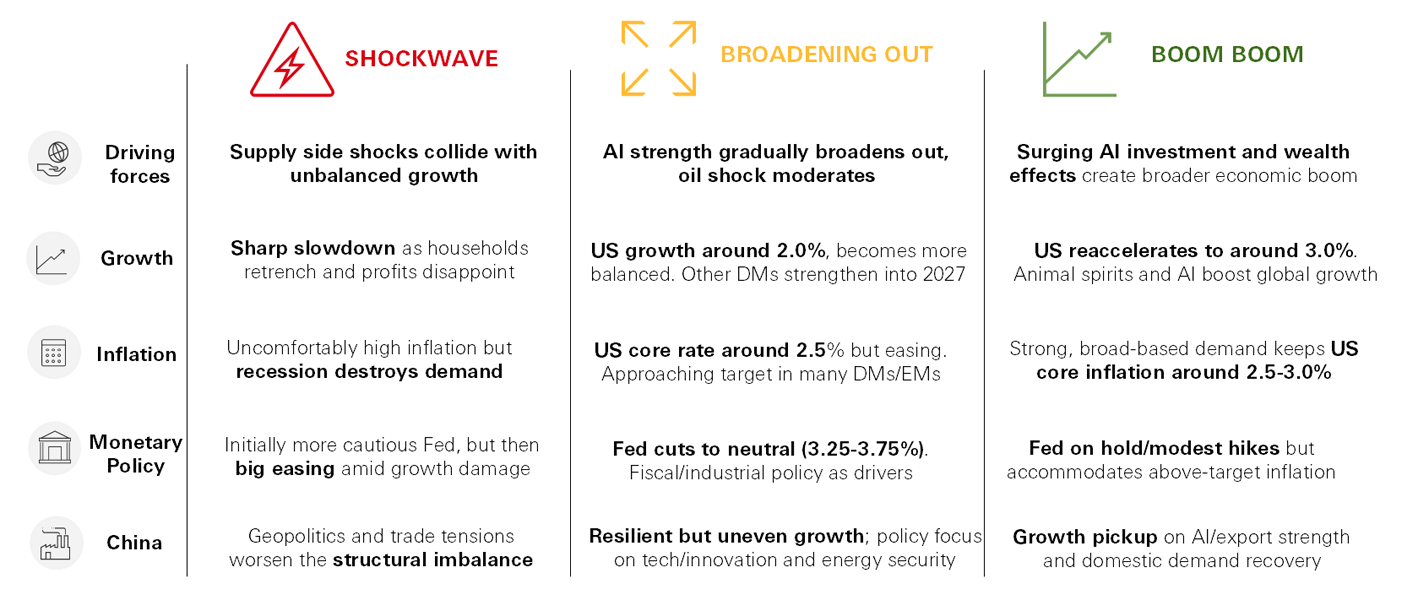
Click the image to enlarge
The commentary and analysis presented in this document reflect the opinion of HSBC Asset Management on the markets, according to the information available to date. They do not constitute any kind of commitment from HSBC Asset Management. Consequently, HSBC Asset Management will not be held responsible for any investment or disinvestment decision taken on the basis of the commentary and/or analysis in this document. Any forecast, projection or target where provided is indicative only and is not guaranteed in any way. HSBC Asset Management accepts no liability for any failure to meet such forecast, projection or target. For informational purposes only and should not be construed as a recommendation to invest in the specific country, product, strategy, sector, or security.
Source: HSBC Asset Management, September 2026.
Click the image to enlarge
The commentary and analysis presented in this document reflect the opinion of HSBC Asset Management on the markets, according to the information available to date. They do not constitute any kind of commitment from HSBC Asset Management. Consequently, HSBC Asset Management will not be held responsible for any investment or disinvestment decision taken on the basis of the commentary and/or analysis in this document. Any forecast, projection or target where provided is indicative only and is not guaranteed in any way. HSBC Asset Management accepts no liability for any failure to meet such forecast, projection or target. For informational purposes only and should not be construed as a recommendation to invest in the specific country, product, strategy, sector, or security.
Source: HSBC Asset Management, September 2026.
Economic outlook
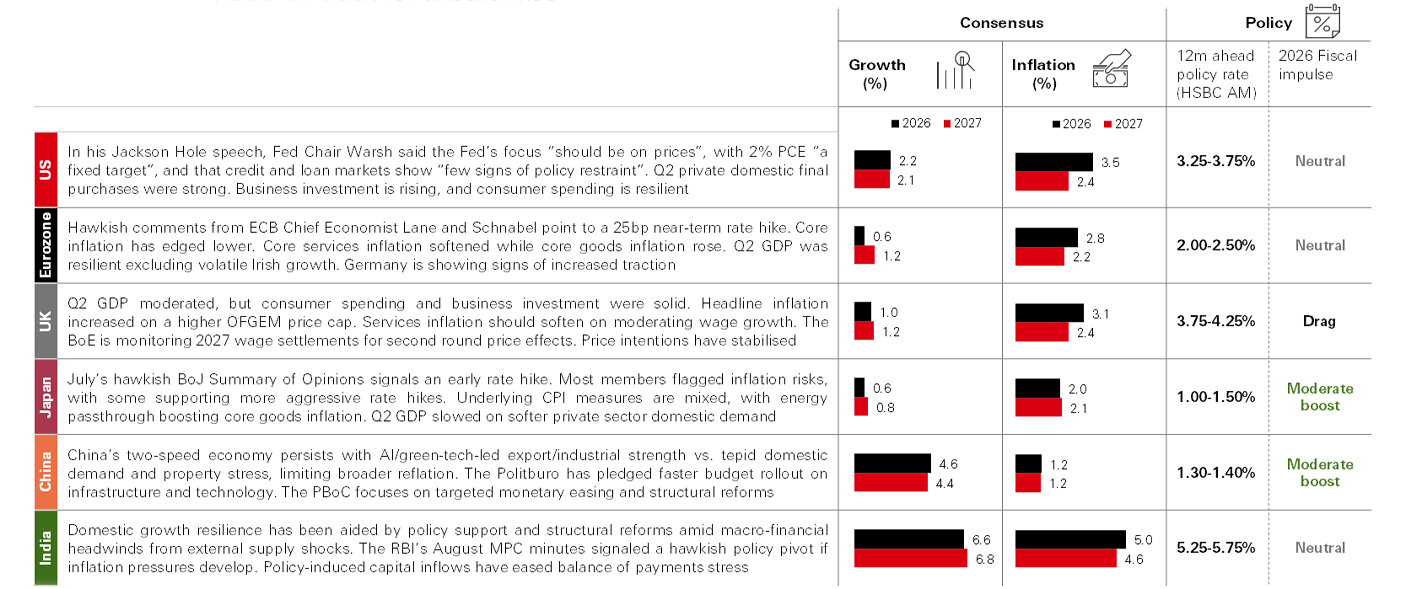
Hawkish Warsh, ECB on track for another rise
Click the image to enlarge
The commentary and analysis presented in this document reflect the opinion of HSBC Asset Management on the markets, according to the information available to date. They do not constitute any kind of commitment from HSBC Asset Management. Consequently, HSBC Asset Management will not be held responsible for any investment or disinvestment decision taken on the basis of the commentary and/or analysis in this document. Any forecast, projection or target where provided is indicative only and is not guaranteed in any way. HSBC Asset Management accepts no liability for any failure to meet such forecast, projection or target. For informational purposes only and should not be construed as a recommendation to invest in the specific country, product, strategy, sector, or security.
Source: HSBC Asset Management, consensus numbers from Bloomberg, September 2026.
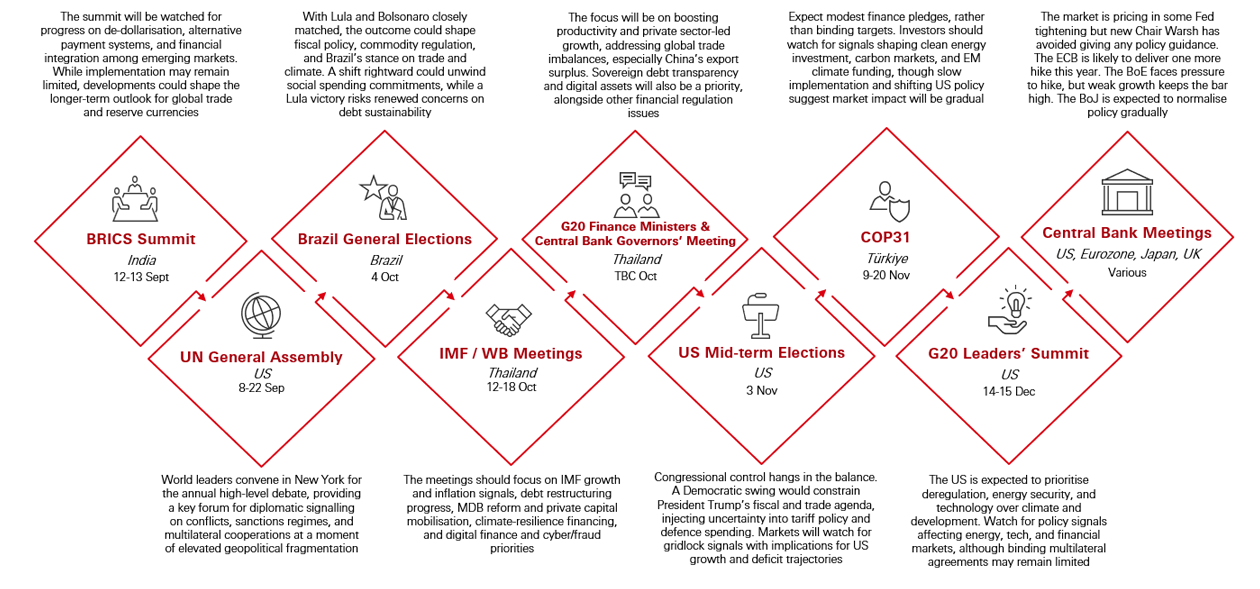
Events calendar: H2 2026
Click the image to enlarge
The commentary and analysis presented in this document reflect the opinion of HSBC Asset Management on the markets, according to the information available to date. They do not constitute any kind of commitment from HSBC Asset Management. Consequently, HSBC Asset Management will not be held responsible for any investment or disinvestment decision taken on the basis of the commentary and/or analysis in this document. The views expressed above were held at the time of preparation and are subject to change without notice. Any forecast, projection or target where provided is indicative only and is not guaranteed in any way. HSBC Asset Management accepts no liability for any failure to meet such forecast, projection or target. Past performance does not predict future returns. For informational purposes only and should not be construed as a recommendation to invest in the specific country, product, strategy, sector, or security.
Source: HSBC Asset Management, September 2026.
Investment Views
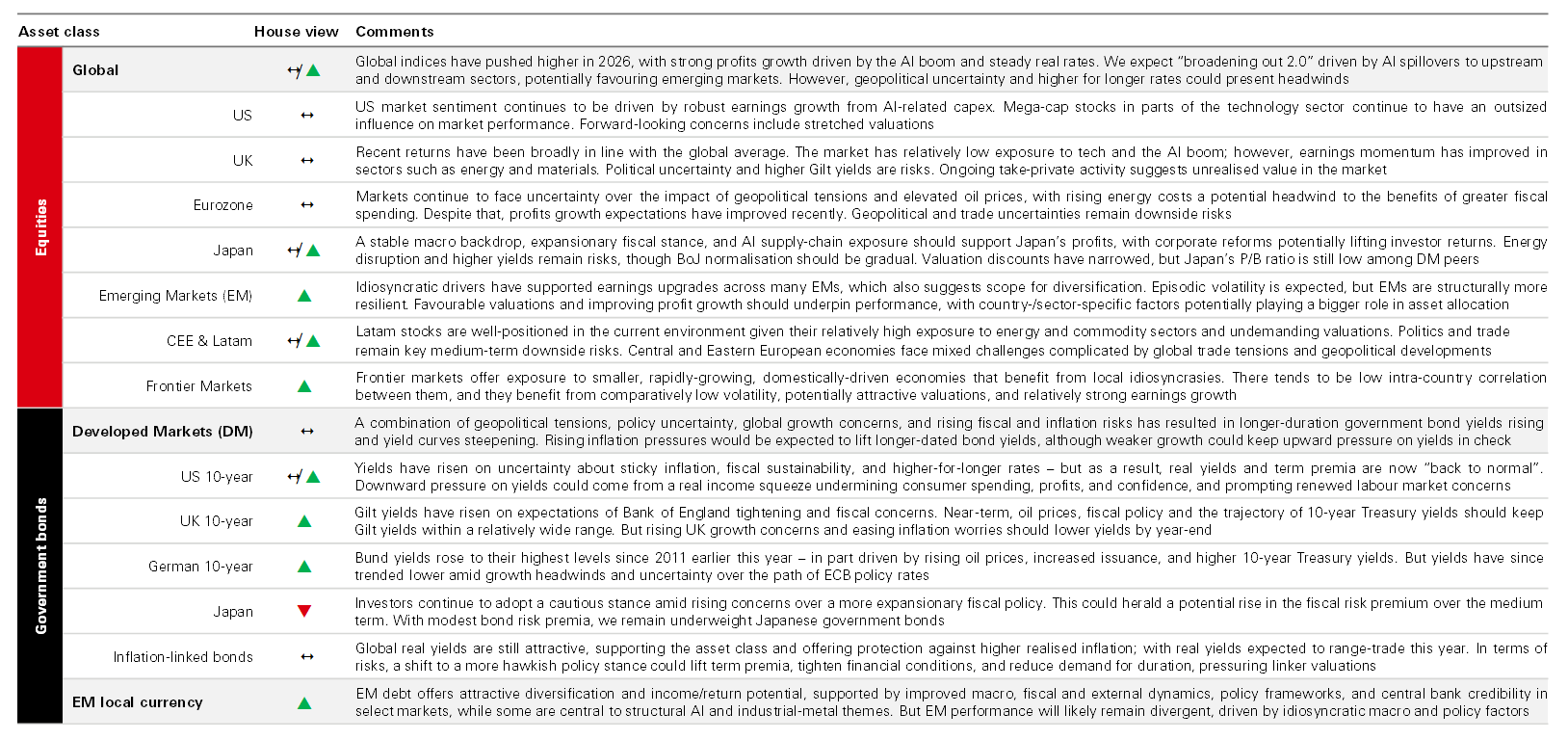
Asset class positioning
Click the image to enlarge
Past performance does not predict future returns. The level of yield is not guaranteed and may rise or fall in the future. Diversification does not ensure a profit or protect against loss. The views expressed above were held at the time of preparation and are subject to change without notice. For informational purposes only and should not be construed as a recommendation to invest in the specific country, product, strategy, sector, or security. Index returns assume reinvestment of all distributions and do not reflect fees or expenses. You cannot invest directly in an index. Source: HSBC Asset Management as at September 2026.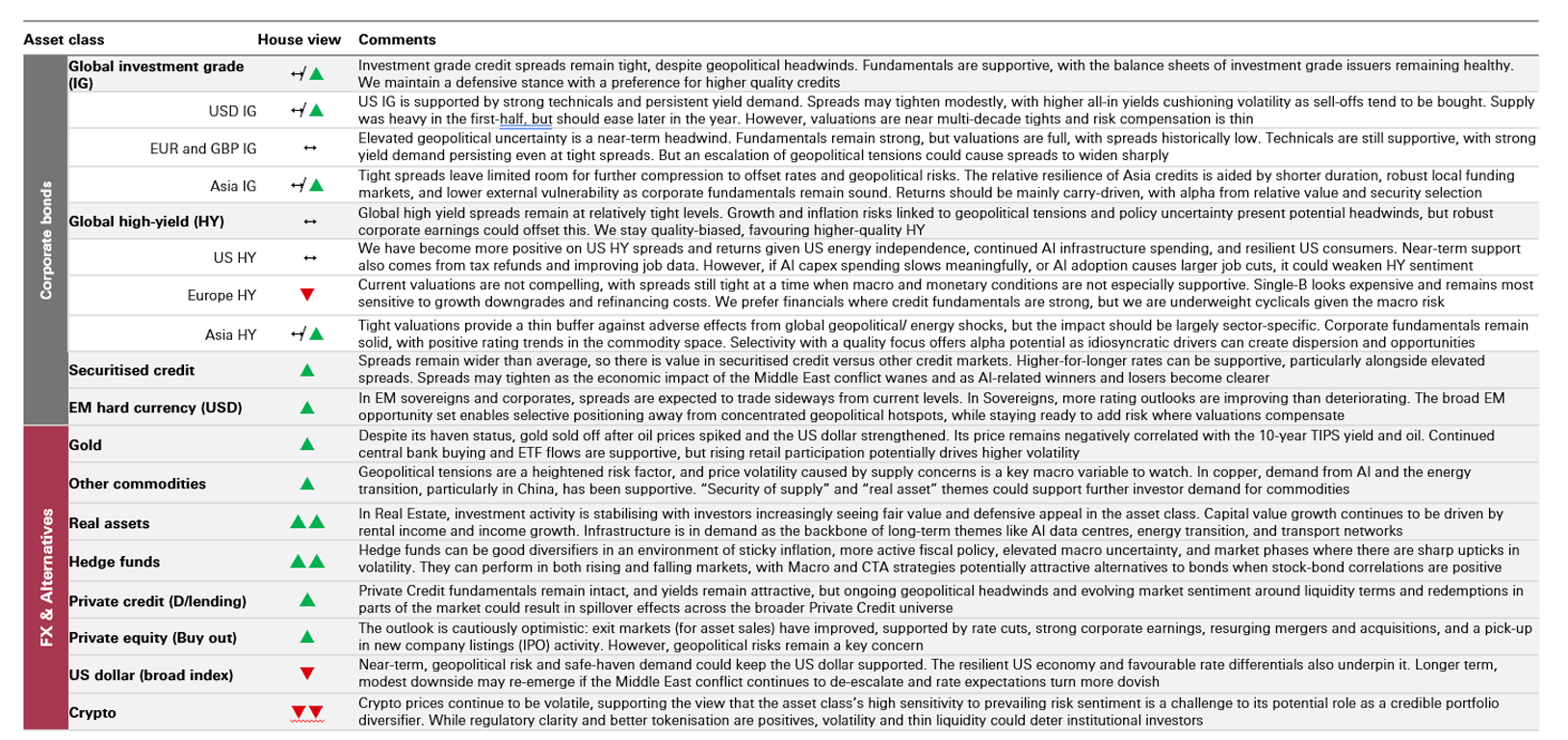
Click the image to enlarge
Past performance does not predict future returns. The level of yield is not guaranteed and may rise or fall in the future. Diversification does not ensure a profit or protect against loss. The views expressed above were held at the time of preparation and are subject to change without notice. For informational purposes only and should not be construed as a recommendation to invest in the specific country, product, strategy, sector, or security. Index returns assume reinvestment of all distributions and do not reflect fees or expenses. You cannot invest directly in an index. Source: HSBC Asset Management as at September 2026.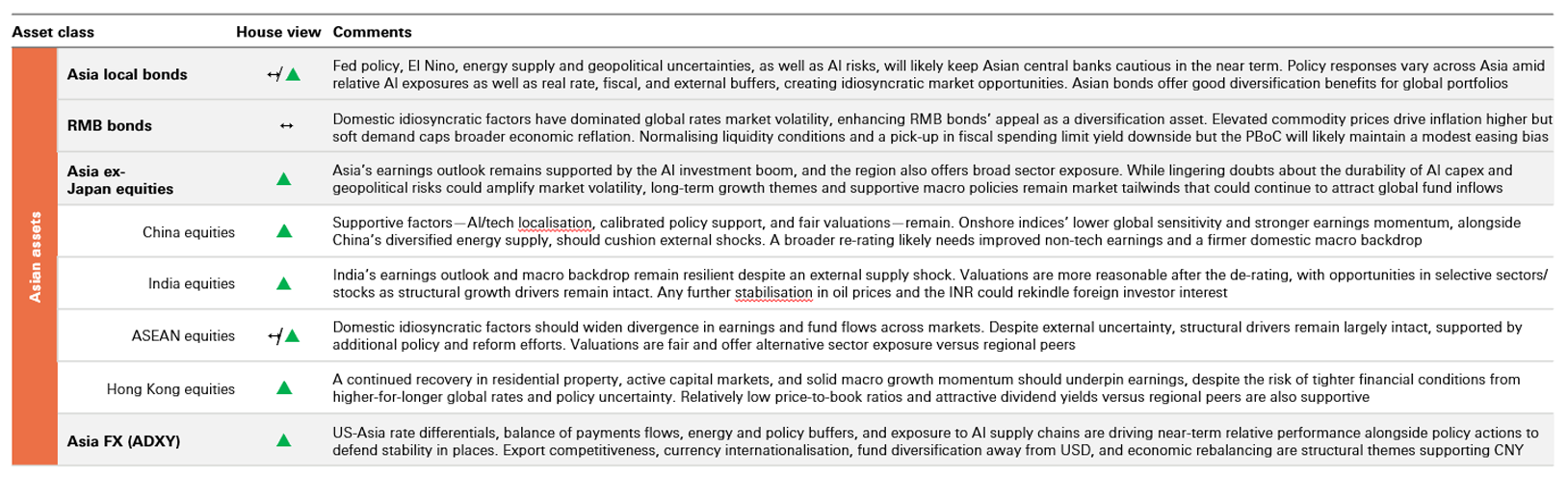
Click the image to enlarge
Past performance does not predict future returns. The level of yield is not guaranteed and may rise or fall in the future. Diversification does not ensure a profit or protect against loss. The views expressed above were held at the time of preparation and are subject to change without notice. For informational purposes only and should not be construed as a recommendation to invest in the specific country, product, strategy, sector, or security. Index returns assume reinvestment of all distributions and do not reflect fees or expenses. You cannot invest directly in an index. Source: HSBC Asset Management as at September 2026.On Top of Investors’ Minds
It’s “La Rentrée!” But as investors return from holiday, what key questions are markets facing?
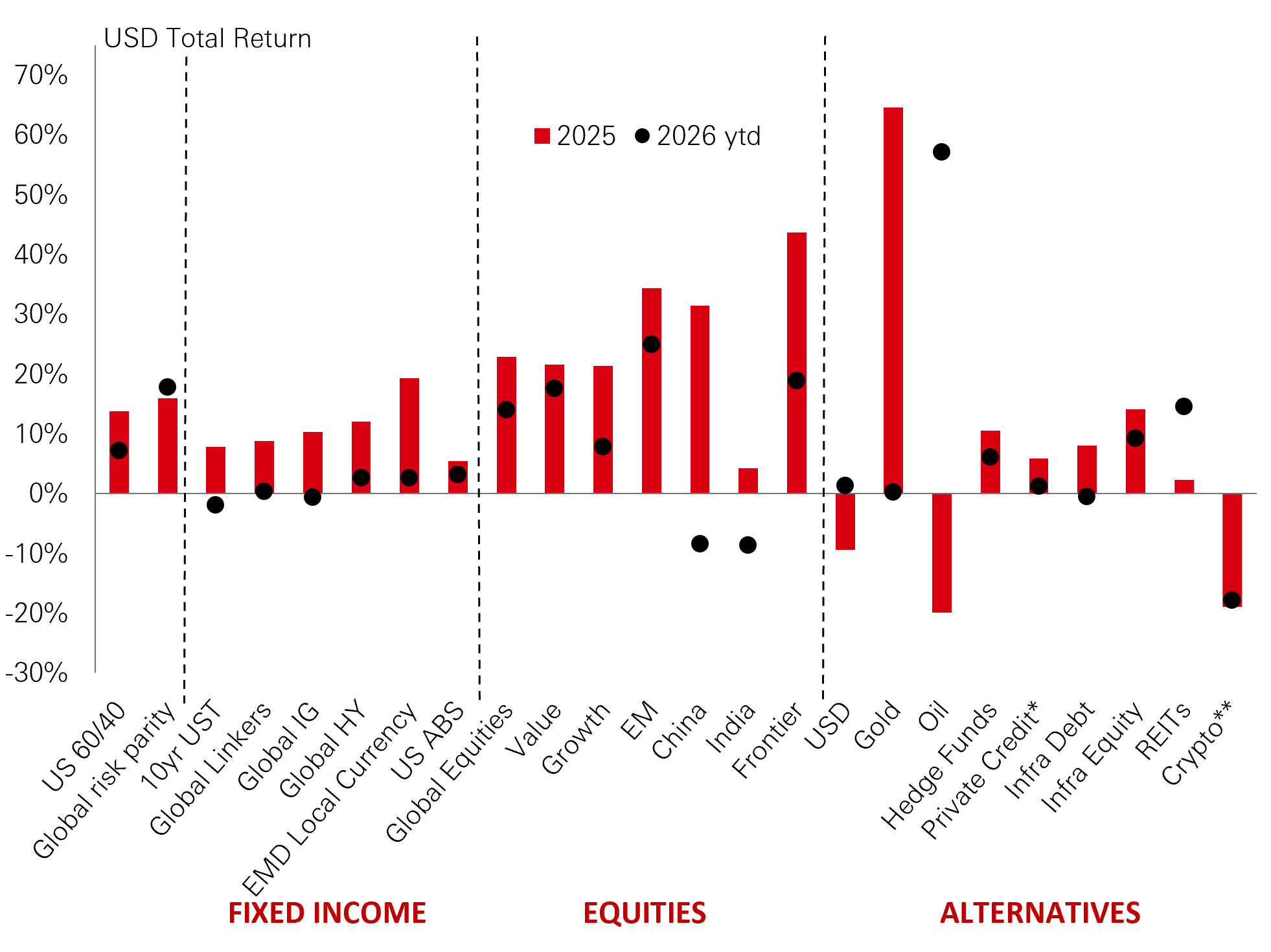
Stock markets have climbed a wall of worry in 2026. The US, Europe, and Japan have seen double-digit gains, and it’s been similar story in emerging markets. The laggards have been the “sleeping giants” of China and India. Meanwhile, bond market action has been more volatile. So, what are the key questions?
- Top of the list is Federal Reserve policy. Chair Warsh struck a hawkish tone at Jackson Hole, but is he serious about a September rate hike? If so, how would markets react?
- Worries over “deficits forever” have sparked volatility in government bond markets, but real yields and term premia are “back to normal”. Could it tempt investors back to G7 fixed income?
- Credit spreads have resisted sovereign bond volatility – but why? With fortress balance sheets, good profits, and lots of supply, investors are using high-quality credit to “diversify the diversifiers”.
- Equities have been resilient, but what could stop them? An AI wobble, geopolitics, and rising bond yields are all risks. Otherwise, the market story this summer has been about “broadening out”.
- Finally, is the debasement trade back on? The Fed backing away from hiking, possible yield caps, and deficit anxieties could all be catalysts for dollar weakness – which could be a boost for emerging markets.
Major asset class returns: 2025 and 2026 year-to-date
Click the image to enlarge
The commentary and analysis presented in this document reflect the opinion of HSBC Asset Management on the markets, according to the information available to date. They do not constitute any kind of commitment from HSBC Asset Management. Consequently, HSBC Asset Management will not be held responsible for any investment or disinvestment decision taken on the basis of the commentary and/or analysis in this document. Any forecast, projection or target where provided is indicative only and is not guaranteed in any way. HSBC Asset Management accepts no liability for any failure to meet such forecast, projection or target. For informational purposes only and should not be construed as a recommendation to invest in the specific country, product, strategy, sector, or security. Past performance does not predict future returns. Diversification does not ensure a profit or protect against loss. You cannot invest directly in an index. The level of yield is not guaranteed and may rise or fall in the future. Source: HSBC Asset Management as at September 2026.
Bond markets have been volatile recently, so what is influencing yields?
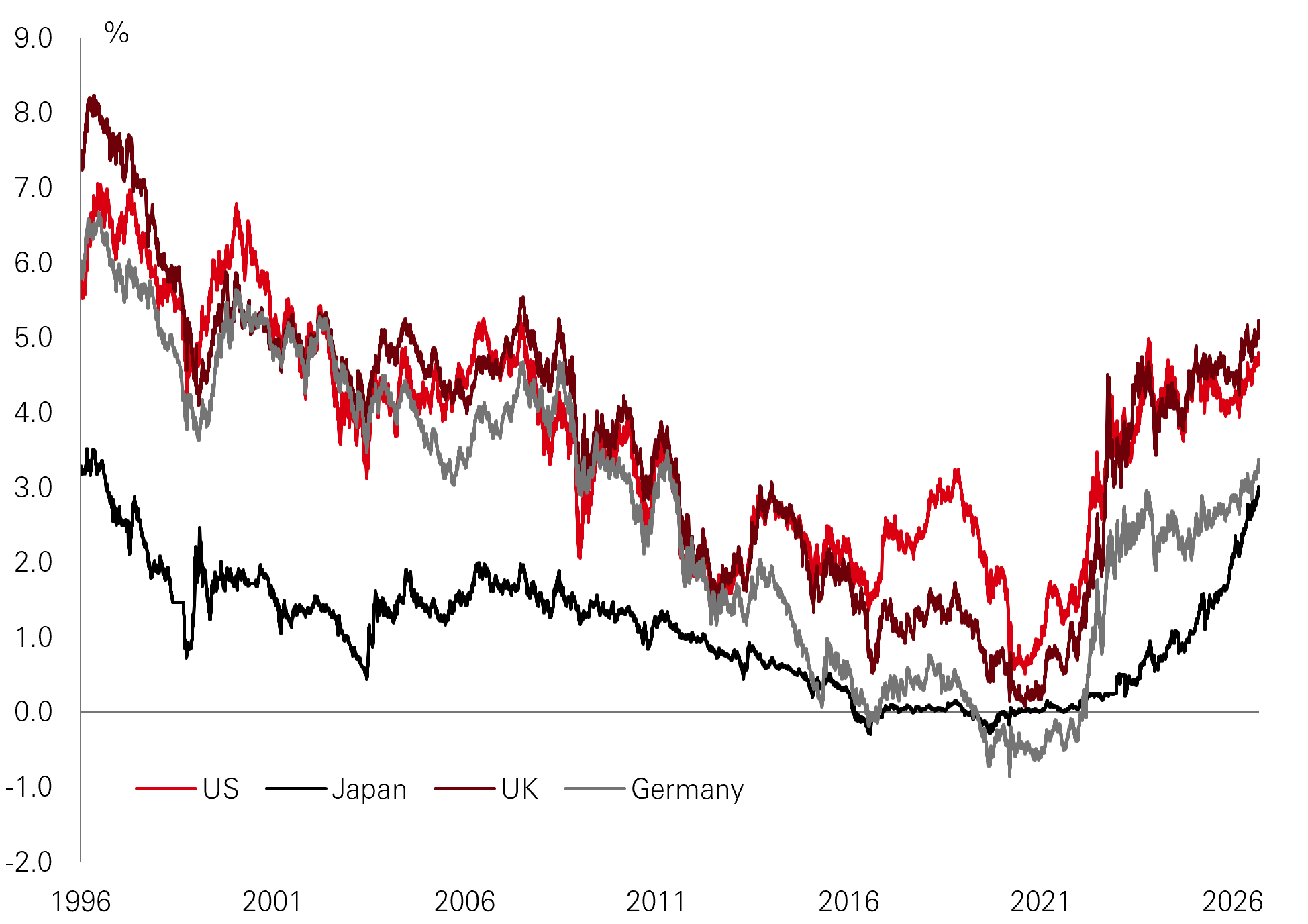
Government bond yields have been making headlines across the G7. But for investors it’s not simply the speed of the rise or the level of yields that matter – it is the reasons for the moves. In the US, real yields have driven the increase this year with the term premium also rising. Longer-term inflation expectations have picked up since late June but are still below the level seen coming into 2026. This suggests the market is pricing more than simply a renewed inflation shock: concerns about fiscal sustainability, debt supply, and geopolitical risk are increasingly leading investors to demand a greater return for holding long-dated government bonds. The bond vigilantes are getting restless.
Governments may want lower borrowing costs, but investors ultimately decide what return they need to finance them. Treasury Secretary Scott Bessent has already sought to ease pressure on the long end of the US curve, including by increasing Treasury buybacks. The fact that yields have subsequently moved higher again is a reminder that the bond market cannot simply be managed by policymakers.
The good news is that historically, high starting yields and a steeper curve have tended to improve the prospective return from fixed income.
30-year government bond yields
Click the image to enlarge
The commentary and analysis presented in this document reflect the opinion of HSBC Asset Management on the markets, according to the information available to date. They do not constitute any kind of commitment from HSBC Asset Management. Consequently, HSBC Asset Management will not be held responsible for any investment or disinvestment decision taken on the basis of the commentary and/or analysis in this document. Any forecast, projection or target where provided is indicative only and is not guaranteed in any way. HSBC Asset Management accepts no liability for any failure to meet such forecast, projection or target. For informational purposes only and should not be construed as a recommendation to invest in the specific country, product, strategy, sector, or security. Past performance does not predict future returns. Diversification does not ensure a profit or protect against loss. You cannot invest directly in an index. The level of yield is not guaranteed and may rise or fall in the future. Source: HSBC Asset Management as at September 2026.Equity markets have been resilient over the summer – but what could stop stocks?
Equity markets have been extremely resilient recently, with stellar profits, easy financial conditions, and “deficits forever” all keeping stocks close to new highs. So, what stops them?
AI is one risk. High valuations, tech concentration, a capex wobble, financing worries, and cash flows rolling-over all need to be watched. Renewed geopolitical uncertainty is also a risk, and so is the recent move higher in longer-duration government bond yields.
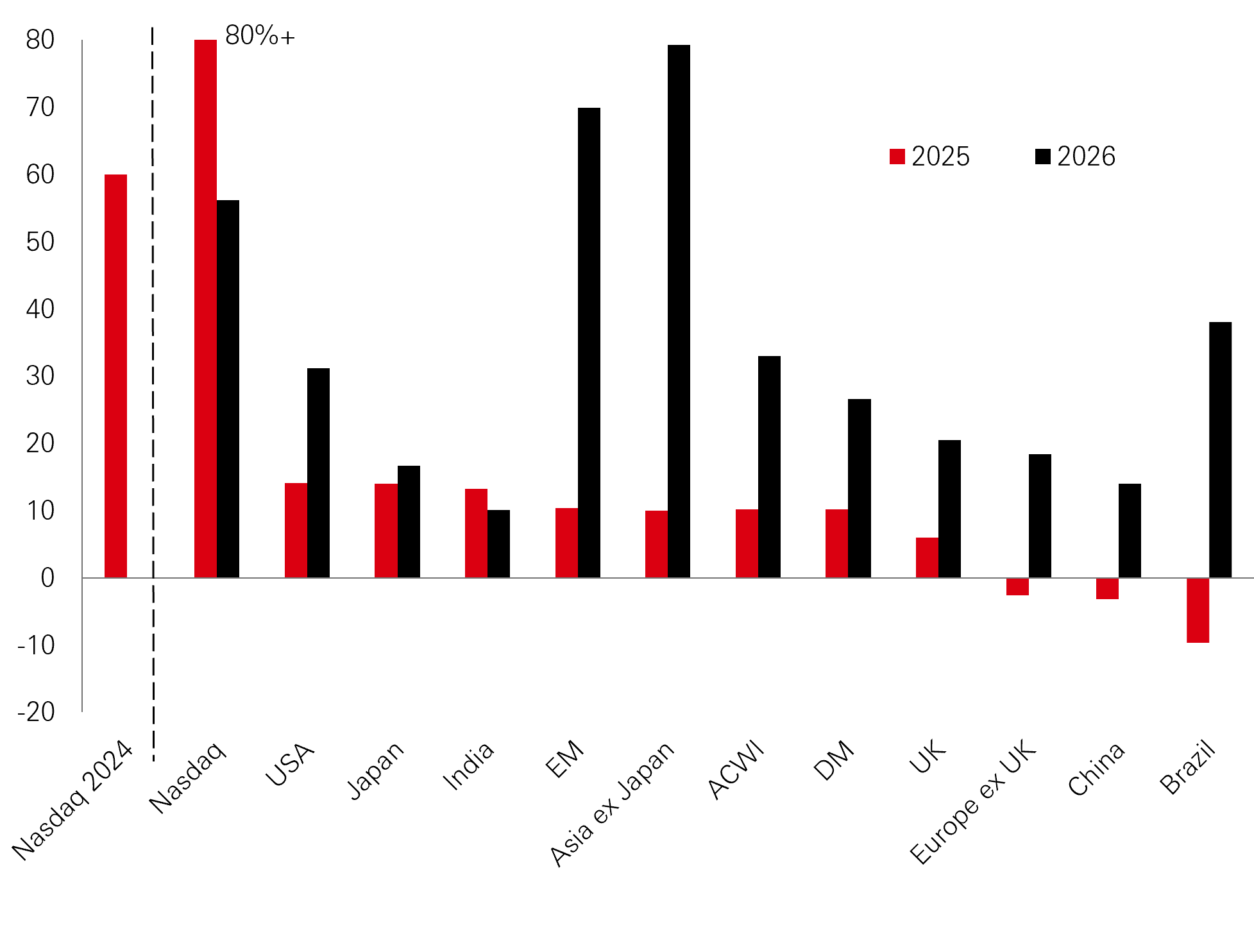
Otherwise, the market story this summer has increasingly been about “broadening out”. We have seen it in “boring” parts of the market: Japan, the UK, Europe, the low-volatility factor, and other value plays. In fact, European stocks have kept pace with the US this year despite the continent’s subdued GDP growth and lack of the same deep AI exposure that the US benefits from. European earnings are now accelerating after two years of zero growth. With starting expectations and valuations lower, it potentially reinforces Europe as an “anti-bubble” market.
More generally, the global opportunity set may be widening. While AI clearly still dominates, firmer profits momentum in Europe and continued strength in parts of emerging markets is further evidence of broadening out.
Global EPS growth per cent (IBES consensus forecast)
Click the image to enlarge
The commentary and analysis presented in this document reflect the opinion of HSBC Asset Management on the markets, according to the information available to date. They do not constitute any kind of commitment from HSBC Asset Management. Consequently, HSBC Asset Management will not be held responsible for any investment or disinvestment decision taken on the basis of the commentary and/or analysis in this document. Any forecast, projection or target where provided is indicative only and is not guaranteed in any way. HSBC Asset Management accepts no liability for any failure to meet such forecast, projection or target. For informational purposes only and should not be construed as a recommendation to invest in the specific country, product, strategy, sector, or security. Past performance does not predict future returns. Diversification does not ensure a profit or protect against loss. You cannot invest directly in an index. The level of yield is not guaranteed and may rise or fall in the future. Source: HSBC Asset Management as at September 2026.Market Data
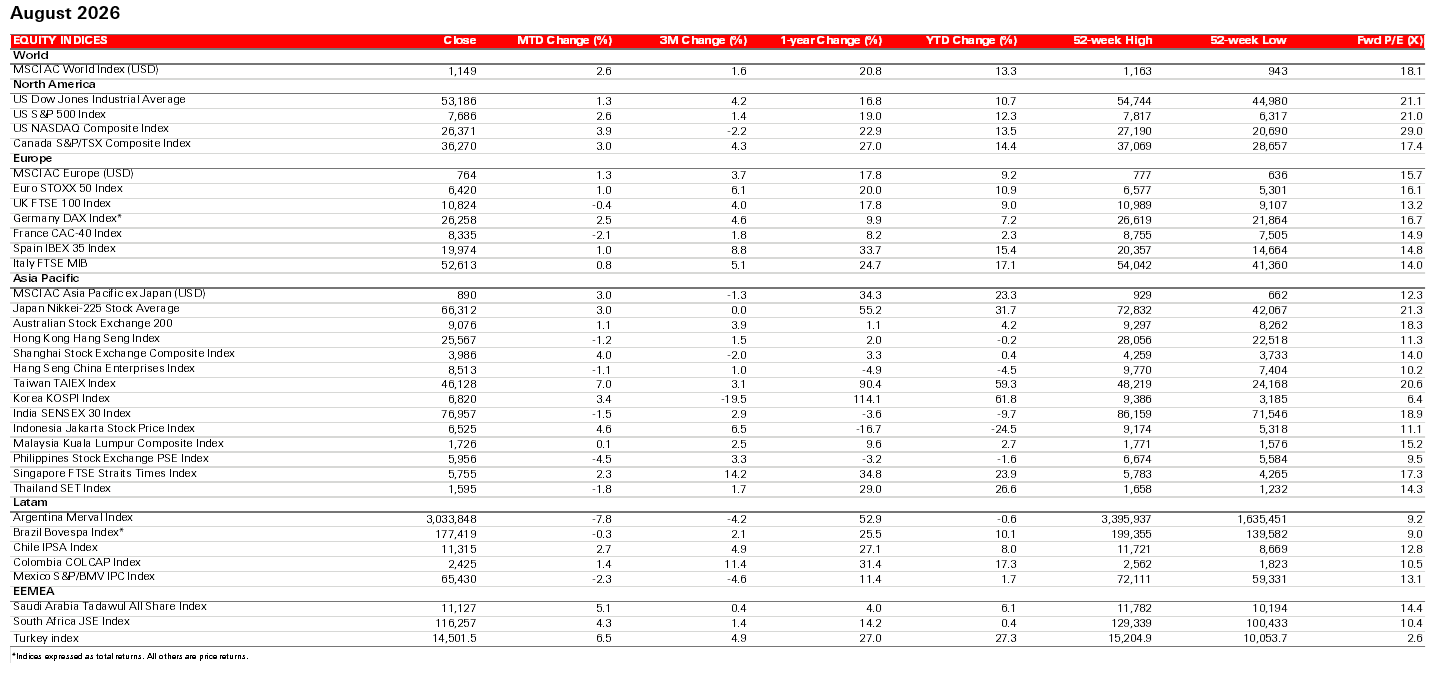
Click the image to enlarge
Past performance does not predict future returns. The level of yield is not guaranteed and may rise or fall in the future. For informational purposes only and should not be construed as a recommendation to invest in the specific country, product, strategy, sector, or security. Index returns assume reinvestment of all distributions and do not reflect fees or expenses. You cannot invest directly in an index. Sources: Bloomberg, HSBC Asset Management. Data as at close of business 31 August 2026. (*) Indices expressed as total returns. All others are price returns.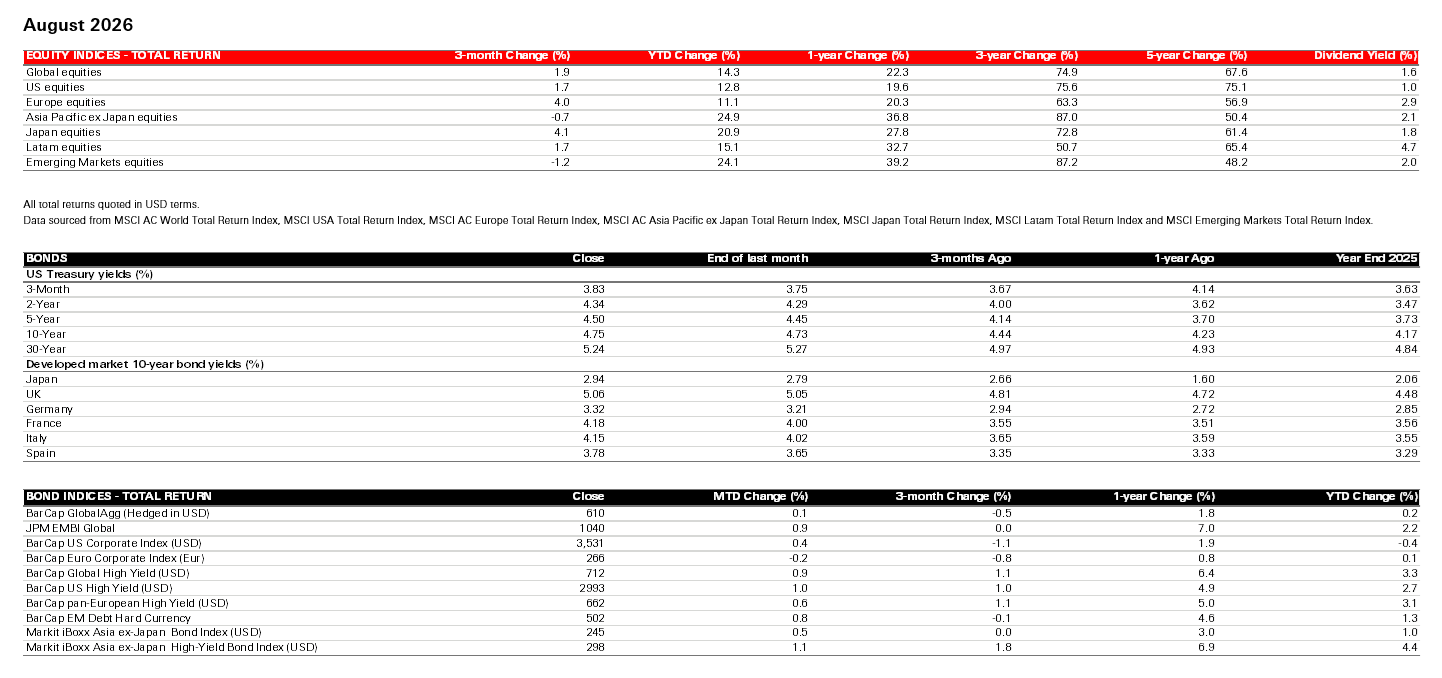
Click the image to enlarge
Total return includes income from dividends and interest as well as appreciation or depreciation in the price of an asset over the given period. Past performance does not predict future returns. The level of yield is not guaranteed and may rise or fall in the future. This information shouldn’t be considered as a recommendation to invest in the country or sector shown. Index returns assume reinvestment of all distributions and do not reflect fees or expenses. You cannot invest directly in an index. Sources: Bloomberg, HSBC Asset Management. Data as at close of business 31 August 2026.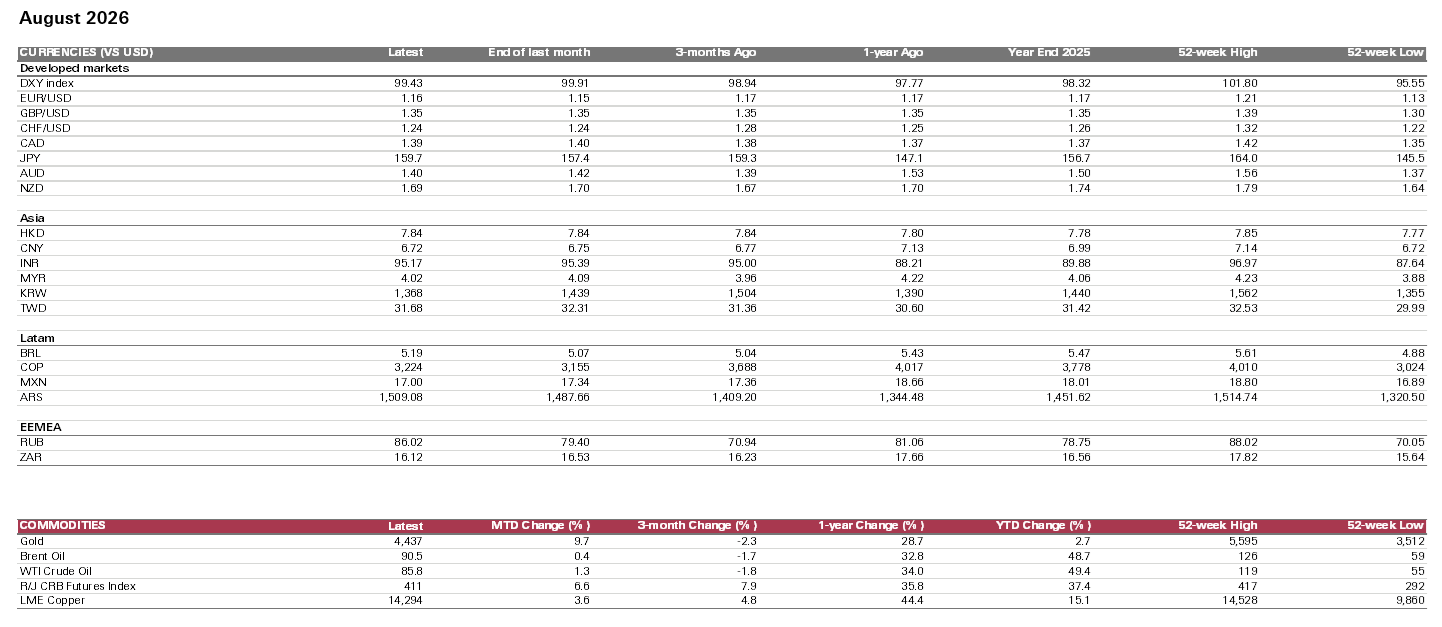
Click the image to enlarge
Past performance does not predict future returns. The level of yield is not guaranteed and may rise or fall in the future. This information shouldn’t be considered as a recommendation to invest in the country or sector shown. Index returns assume reinvestment of all distributions and do not reflect fees or expenses. You cannot invest directly in an index. Sources: Bloomberg, HSBC Asset Management. Data as at close of business 31 August 2026.Important Information
Basis of Views and Definitions of ‘Asset class positioning’ tables
- Views are based on regional HSBC Asset Management Asset Allocation meetings held throughout August 2026, HSBC Asset Management’s long-term expected return forecasts which were generated as at 30 July 2026, our portfolio optimisation process and actual portfolio positions.
- Icons: ⭡ View on this asset class has been upgraded – No change 🠗 View on this asset class has been downgraded.
- Underweight, overweight and neutral classifications are the high-level asset allocations tilts applied in diversified, typically multi-asset portfolios, which reflect a combination of our long-term valuation signals, our shorter-term cyclical views and actual positioning in portfolios. The views are expressed with reference to global portfolios. However, individual portfolio positions may vary according to mandate, benchmark, risk profile and the availability and riskiness of individual asset classes in different regions.
- “Overweight” implies that, within the context of a well-diversified typically multi-asset portfolio, and relative to relevant internal or external benchmarks, HSBC Global Asset Management has (or would have) a positive tilt towards the asset class.
- “Underweight” implies that, within the context of a well-diversified typically multi-asset portfolio, and relative to relevant internal or external benchmarks, HSBC Global Asset Management has (or would) have a negative tilt towards the asset class.
- “Neutral” implies that, within the context of a well-diversified typically multi-asset portfolio, and relative to relevant internal or external benchmarks HSBC Global Asset Management has (or would have) neither a particularly negative or positive tilt towards the asset class.
- For global investment-grade corporate bonds, the underweight, overweight and neutral categories for the asset class at the aggregate level are also based on high-level asset allocation considerations applied in diversified, typically multi-asset portfolios. However, USD investment-grade corporate bonds and EUR and GBP investment-grade corporate bonds are determined relative to the global investment-grade corporate bond universe.
- For Asia ex Japan equities, the underweight, overweight and neutral categories for the region at the aggregate level are also based on high-level asset allocation considerations applied in diversified, typically multi-asset portfolios. However, individual country views are determined relative to the Asia ex Japan equities universe as of 30 July 2026.
- Similarly, for EM government bonds, the underweight, overweight and neutral categories for the asset class at the aggregate level are also based on high-level asset allocation considerations applied in diversified, typically multi-asset portfolios. However, EM Asian Fixed income views are determined relative to the EM government bonds (hard currency) universe as of 31 August 2026.
Important information
For Professional Clients and intermediaries within countries and territories set out below; and for Institutional Investors and Financial Advisors in the US. This document should not be distributed to or relied upon by Retail clients/investors.
The value of investments and the income from them can go down as well as up and investors may not get back the amount originally invested. The performance figures contained in this document relate to past performance, which should not be seen as an indication of future returns. Future returns will depend, inter alia, on market conditions, investment manager’s skill, risk level and fees. Where overseas investments are held the rate of currency exchange may cause the value of such investments to go down as well as up. Investments in emerging markets are by their nature higher risk and potentially more volatile than those inherent in some established markets. Economies in emerging markets generally are heavily dependent upon international trade and, accordingly, have been and may continue to be affected adversely by trade barriers, exchange controls, managed adjustments in relative currency values and other protectionist measures imposed or negotiated by the countries and territories with which they trade. These economies also have been and may continue to be affected adversely by economic conditions in the countries and territories in which they trade.
The contents of this document may not be reproduced or further distributed to any person or entity, whether in whole or in part, for any purpose. All non-authorised reproduction or use of this document will be the responsibility of the user and may lead to legal proceedings. The material contained in this document is for general information purposes only and does not constitute advice or a recommendation to buy or sell investments. Some of the statements contained in this document may be considered forward looking statements which provide current expectations or forecasts of future events. Such forward looking statements are not guarantees of future performance or events and involve risks and uncertainties. Actual results may differ materially from those described in such forward-looking statements as a result of various factors. We do not undertake any obligation to update the forward-looking statements contained herein, or to update the reasons why actual results could differ from those projected in the forward-looking statements. This document has no contractual value and is not by any means intended as a solicitation, nor a recommendation for the purchase or sale of any financial instrument in any jurisdiction in which such an offer is not lawful. The views and opinions expressed herein are those of HSBC Asset Management at the time of preparation and are subject to change at any time. These views may not necessarily indicate current portfolios' composition. Individual portfolios managed by HSBC Asset Management primarily reflect individual clients' objectives, risk preferences, time horizon, and market liquidity. Foreign and emerging markets: investments in foreign markets involve risks such as currency rate fluctuations, potential differences in accounting and taxation policies, as well as possible political, economic, and market risks. These risks are heightened for investments in emerging markets which are also subject to greater illiquidity and volatility than developed foreign markets. This commentary is for information purposes only. It is a marketing communication and does not constitute investment advice or a recommendation to any reader of this content to buy or sell investments nor should it be regarded as investment research. It has not been prepared in accordance with legal requirements designed to promote the independence of investment research and is not subject to any prohibition on dealing ahead of its dissemination. This document is not contractually binding nor are we required to provide this to you by any legislative provision.
All data from HSBC Asset Management unless otherwise specified. Any third-party information has been obtained from sources we believe to be reliable, but which we have not independently verified. HSBC Asset Management is the brand name for the asset management business of HSBC Group, which includes the investment activities that may be provided through our local regulated entities. HSBC Asset Management is a group of companies in many countries and territories throughout the world that are engaged in investment advisory and fund management activities, which are ultimately owned by HSBC Holdings Plc. (HSBC Group).
- In Australia, this document is issued by HSBC Bank Australia Limited ABN 48 006 434 162, AFSL 232595, for HSBC Global Asset Management (Hong Kong) Limited ARBN 132 834 149 and HSBC Global Asset Management (UK) Limited ARBN 633 929 718. This document is for institutional investors only and is not available for distribution to retail clients (as defined under the Corporations Act). HSBC Global Asset Management (Hong Kong) Limited and HSBC Global Asset Management (UK) Limited are exempt from the requirement to hold an Australian financial services license under the Corporations Act in respect of the financial services they provide. HSBC Global Asset Management (Hong Kong) Limited is regulated by the Securities and Futures Commission of Hong Kong under the Hong Kong laws, which differ from Australian laws. HSBC Global Asset Management (UK) Limited is regulated by the Financial Conduct Authority of the United Kingdom and, for the avoidance of doubt, includes the Financial Services Authority of the United Kingdom as it was previously known before 1 April 2013, under the laws of the United Kingdom, which differ from Australian laws;
- In Bermuda, this document is issued by HSBC Global Asset Management (Bermuda) Limited, of 37 Front Street, Hamilton, Bermuda which is licensed to conduct investment business by the Bermuda Monetary Authority;
- In France, Belgium, Netherlands, Luxembourg, Portugal, Greece, Finland, Norway, Denmark, Spain and Sweden this document is issued by HSBC Global Asset Management (France), a Portfolio Management Company authorised by the French regulatory authority AMF (no. GP99026);
- In Germany, this document is issued by HSBC Global Asset Management (Deutschland) GmbH which is regulated by BaFin (German clients) respective by the Austrian Financial Market Supervision FMA (Austrian clients);
- In Hong Kong, this document is issued by HSBC Global Asset Management (Hong Kong) Limited, which is regulated by the Securities and Futures Commission. This content has not been reviewed by the Securities and Futures Commission;
- In India, this document is issued by HSBC Asset Management (India) Pvt Ltd. which is regulated by the Securities and Exchange Board of India;
- In Italy, this document is issued by HSBC Global Asset Management (France), a Portfolio Management Company authorised by the French regulatory authority AMF (no. GP99026), through its Italian branch, regulated by Banca d’Italia and Commissione Nazionale per le Società e la Borsa (Consob);
- In Japan, this document is issued by HSBC Asset Management (Japan) Ltd (JRN 3010001124868), regulated by the Financial Services Agency;
- In Malta, this document is issued by HSBC Global Asset Management (Malta) Limited which is regulated and licensed to conduct Investment Services by the Malta Financial Services Authority under the Investment Services Act;
- In Mexico, this document is issued by HSBC Global Asset Management (Mexico), SA de CV, Sociedad Operadora de Fondos de Inversión, Grupo Financiero HSBC which is regulated by Comisión Nacional Bancaria y de Valores;
- In the United Arab Emirates, this document is issued by HSBC Investment Funds (Luxembourg) S.A. – Dubai Branch (Level 20, HSBC Tower, PO Box 66, Downtown Dubai, United Arab Emirates) regulated by the Capital Market Authority (CMA) in the UAE to conduct investment fund management, portfolios management, fund administration activities (CMA Category 2 license No.20200000336) and promotion activities (CMA Category 5 license No.20200000327).
- In the United Arab Emirates, this document is issued by HSBC Global Asset Management MENA, a unit within HSBC Bank Middle East Limited, U.A.E Branch, PO Box 66 Dubai, UAE, regulated by the Central Bank of the U.A.E. and the Capital Market Authority in the UAE under CMA license number 602004 for the purpose of this promotion and lead regulated by the Dubai Financial Services Authority. HSBC Bank Middle East Limited is a member of the HSBC Group and HSBC Global Asset Management MENA are marketing the relevant product only in a sub-distributing capacity on a principal-to-principal basis. HSBC Global Asset Management MENA may not be licensed under the laws of the recipient’s country of residence and therefore may not be subject to supervision of the local regulator in the recipient’s country of residence. One of more of the products and services of the manufacturer may not have been approved by or registered with the local regulator and the assets may be booked outside of the recipient’s country of residence.
- In Singapore, this document is issued by HSBC Global Asset Management (Singapore) Limited, which is regulated by the Monetary Authority of Singapore. The content in the document/video has not been reviewed by the Monetary Authority of Singapore;
- In Switzerland, this document is issued by HSBC Global Asset Management (Switzerland) AG. This document is intended for professional investor use only. For opting in and opting out according to FinSA, please refer to our website; if you wish to change your client categorization, please inform us. HSBC Global Asset Management (Switzerland) AG having its registered office at Gartenstrasse 26, PO Box, CH-8002 Zurich has a licence as an asset manager of collective investment schemes and as a representative of foreign collective investment schemes. Disputes regarding legal claims between the Client and HSBC Global Asset Management (Switzerland) AG can be settled by an ombudsman in mediation proceedings. HSBC Global Asset Management (Switzerland) AG is affiliated to the ombudsman FINOS having its registered address at Talstrasse 20, 8001 Zurich. There are general risks associated with financial instruments, please refer to the Swiss Banking Association (“SBA”) Brochure “Risks Involved in Trading in Financial Instruments”;
- In Taiwan, this document is issued by HSBC Global Asset Management (Taiwan) Limited which is regulated by the Financial Supervisory Commission R.O.C. (Taiwan);
- In Turkiye, this document is issued by HSBC Asset Management A.S. Turkiye (AMTU) which is regulated by Capital Markets Board of Turkiye. Any information here is not intended to distribute in any jurisdiction where AMTU does not have a right to. Any views here should not be perceived as investment advice, product/service offer and/or promise of income. Information given here might not be suitable for all investors and investors should be giving their own independent decisions. The investment information, comments and advice given herein are not part of investment advice activity. Investment advice services are provided by authorized institutions to persons and entities privately by considering their risk and return preferences, whereas the comments and advice included herein are of a general nature. Therefore, they may not fit your financial situation and risk and return preferences. For this reason, making an investment decision only by relying on the information given herein may not give rise to results that fit your expectations.
- In the UK, this document is issued by HSBC Global Asset Management (UK) Limited, which is authorised and regulated by the Financial Conduct Authority;
- In the US, this document is issued by HSBC Securities (USA) Inc., an HSBC broker dealer registered in the US with the Securities and Exchange Commission under the Securities Exchange Act of 1934. HSBC Securities (USA) Inc. is also a member of NYSE/FINRA/SIPC. HSBC Securities (USA) Inc. is not authorized by or registered with any other non-US regulatory authority. The contents of this document are confidential and may not be reproduced or further distributed to any person or entity, whether in whole or in part, for any purpose without prior written permission.
- In Chile, operations by HSBC's headquarters or other offices of this bank located abroad are not subject to Chilean inspections or regulations and are not covered by warranty of the Chilean state. Obtain information about the state guarantee to deposits at your bank or on www.cmfchile.cl;
- In Colombia, HSBC Bank USA NA has an authorized representative by the Superintendencia Financiera de Colombia (SFC) whereby its activities conform to the General Legal Financial System. SFC has not reviewed the information provided to the investor. This document is for the exclusive use of institutional investors in Colombia and is not for public distribution;
- In Costa Rica, the Fund and any other products or services referenced in this document are not registered with the Superintendencia General de Valores (“SUGEVAL”) and no regulator or government authority has reviewed this document, or the merits of the products and services referenced herein. This document is directed at and intended for institutional investors only.
- In Peru, HSBC Bank USA NA has an authorized representative by the Superintendencia de Banca y Seguros in Perú whereby its activities conform to the General Legal Financial System - Law No. 26702. Funds have not been registered before the Superintendencia del Mercado de Valores (SMV) and are being placed by means of a private offer. SMV has not reviewed the information provided to the investor. This document is for the exclusive use of institutional investors in Perú and is not for public distribution;
- In Uruguay, operations by HSBC's headquarters or other offices of this bank located abroad are not subject to Uruguayan inspections or regulations and are not covered by warranty of the Uruguayan state. Further information may be obtained about the state guarantee to deposits at your bank or on www.bcu.gub.uy.
Copyright © HSBC Global Asset Management Limited 2026. All rights reserved. No part of this publication may be reproduced, stored in a retrieval system, or transmitted, on any form or by any means, electronic, mechanical, photocopying, recording, or otherwise, without the prior written permission of HSBC Asset Management.
Content ID: D077718_V1.0; Expiry Date: 01.09.2027